
Stop Treating Transcription and Translation Like Features
By Aaron King
Senior Vice President and General Manager, Agency Solutions
Why Context Is Now Core to Emergency Call Handling
When someone calls 9-1-1, the first priority is always the same: connect the caller to someone who can help.
But answering the call is only the beginning.
Within seconds, call takers must understand what is happening, extract critical details, and ensure the right responders receive the right information. In many cases, they are doing this while the caller is distressed, unclear, or unable to communicate effectively.
The job has never been simple. It is becoming more complex.
Calls now arrive through voice, text, and multimedia. Information comes from multiple systems. Callers may speak different languages or struggle to explain what is happening.
In this environment, answering the call is not enough. Understanding the situation quickly is what matters.
The Real Shift: From Calls to Context
Traditional call handling systems were designed for a different model: a voice call, a conversation, and manual note-taking.
That model still exists—but it is no longer sufficient.
Today, ECCs are expected to move faster from a call to a clear understanding of the situation. That requires more than conversation. It requires context.
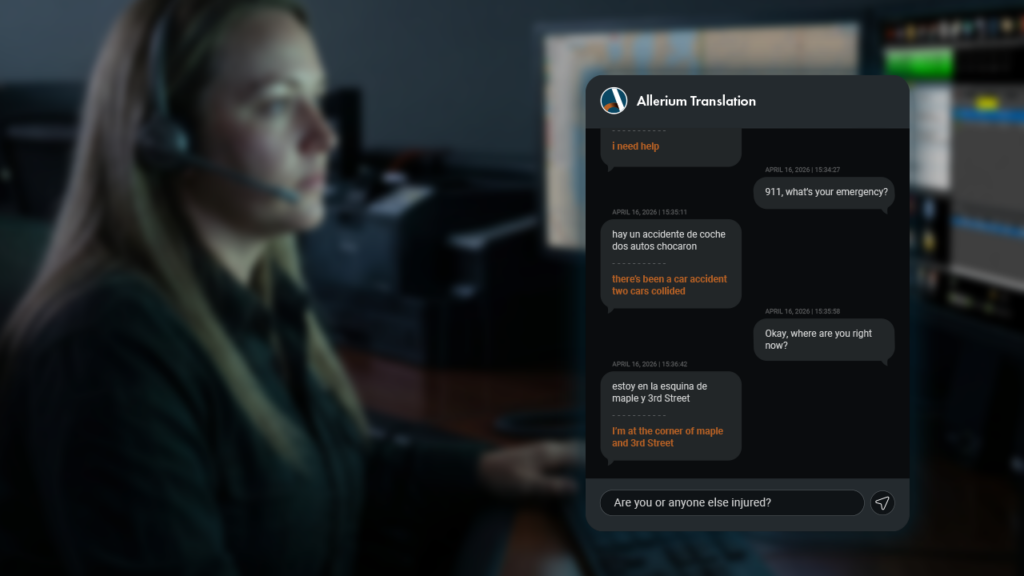
Real-time transcription helps capture critical details as they are spoken. Translation tools allow call takers to communicate clearly when language is a barrier. Integrated data connects information across systems to build a more complete picture of an incident.
Individually, these capabilities may seem incremental. In practice, they change how quickly an ECC can move from listening to acting.
This Is Not About Adding Features
There is a tendency to treat capabilities like transcription and translation as enhancements—useful, but optional.
That view is outdated.
In real-world emergency communications, these tools directly affect how effectively a call taker can do their job. They reduce missed details. They reduce repetition. They help ensure that critical information is captured and shared accurately.
Most importantly, they help call takers stay focused on the caller, instead of managing multiple systems at once.
These are not “nice to have” features. They are operational multipliers.
Designed for the Reality of the ECC
Emergency calls rarely arrive cleanly. They are often incomplete, emotional, and time-sensitive.
Technology should not make that environment harder to manage.
Transcription allows call takers to reference what was said without breaking the flow of the conversation. Translation reduces friction when communication is already difficult. Integrated workflows reduce the need to move between systems while managing an active call.
These capabilities do not replace experience. They support it.
And when they are implemented correctly, they make the entire operation more efficient—not more complex.
Context Beyond the Call
The value of these capabilities extends beyond the live interaction.
Transcription and reporting data give supervisors better visibility into what is happening across the center. They support training, quality assurance, and continuous improvement.
Over time, this data becomes an asset—helping agencies understand patterns, improve response, and operate more effectively.
In environments like California, where ECC leaders are evaluating approved call-handling solutions, this shift matters. The decision is no longer just about answering calls reliably. It is about choosing a platform that helps teams move faster from information to understanding.
A Proven Foundation, with a Clear Path to More
Allerium Guardian reflects this approach. Deployed in more than 800 public safety answering points, it is built on a proven operational foundation that agencies trust to perform when it matters most.
At the same time, capabilities such as transcription, translation, and integrated data workflows are increasingly becoming part of how modern ECCs operate. These capabilities are available within the Guardian platform and can be adopted as agencies evolve their operations.
This allows ECCs to introduce new functionality in a way that fits their environment—without forcing change all at once.
The result is a system that supports both where agencies are today and how they choose to move forward.
Understanding Is the First Step to Response
Emergency communications will continue to evolve. New technologies will emerge, and expectations will continue to grow.
But the goal remains unchanged.
Call takers need to understand what is happening as quickly and clearly as possible.
Because in emergency response, the ability to act starts with the ability to understand.
Part of a Larger Conversation
This is the second post in a series exploring how emergency communications centers are modernizing call handling while maintaining the reliability their operations depend on.
In the first installment, Proven Systems Don’t Have to Mean Outdated Capabilities, we explore why proven systems continue to play a critical role, and how modern capabilities can be introduced without compromising operational confidence.